
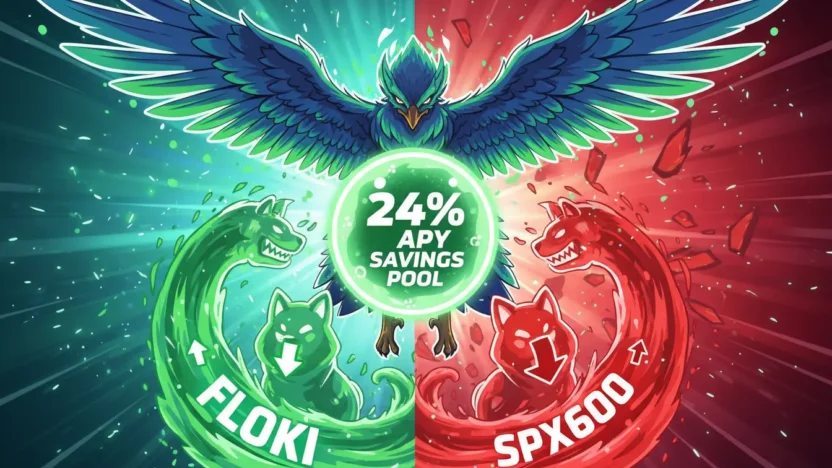
The launch of Varntix’s 24% APY savings pool arrived quietly, but its timing speaks volumes. Positioned alongside two of the most talked-about tokens in the current cycle — Floki and SPX600 — this product rollout is less a routine yield offering and more a calculated signal about where behavioral capital is flowing right now.
What makes this launch genuinely interesting is not the yield figure itself, but what kind of investor it is designed to attract. A 24% APY in a market still scarred by the collapse of algorithmic yield schemes is either a bold value proposition or an exploit of short-term memory. The real question is which camp the market ultimately decides it belongs to.
The pairing with Floki and SPX600 creates a specific narrative architecture. These are not institutional darlings. They are community-driven, retail-magnetizing assets with proven capacity to generate speculative momentum. Varntix is not just launching a savings product — it is launching one directly inside that gravitational field.
Varntix, Floki, and SPX600: why the retail psychology angle is the real story
The dominant narrative mode here is behavioral psychology — specifically, the gap between how retail participants perceive yield products and how they actually perform over time. 💰 Retail investors entering the Floki and SPX600 ecosystems are not yield-maximizers by default. They are momentum chasers who arrived through social channels, meme culture, or community FOMO.
Introducing a structured savings pool with a fixed headline rate into that audience is a deliberate design choice. It converts speculative energy into something that looks like financial discipline. The 24% APY figure functions as a psychological anchor — high enough to feel meaningful, not so astronomical as to trigger the alarm bells that Celsius and Terra burned into collective memory.
This is the non-obvious layer that most coverage will miss. Varntix is not competing with traditional DeFi yield aggregators for sophisticated liquidity providers. It is competing for the attention of people who would otherwise be rotating in and out of meme tokens on weekly cycles. That is a fundamentally different customer — and a much stickier one, if the product delivers.
The SPX600 connection shifts the perceived risk profile
SPX600’s association here deserves its own reading. The token’s name carries an implicit reference to traditional equity benchmarking, and that framing is not accidental. In a cycle where crypto projects increasingly borrow legitimacy signals from TradFi nomenclature, SPX600 occupies an interesting middle ground between meme asset and quasi-institutional branding.
When retail participants see SPX600 alongside a savings pool offering, the subconscious association with index stability does quiet work. It softens the risk perception without changing the underlying risk reality. This is behavioral architecture at its most precise — and Varntix appears to understand it well.
What a 24% APY actually tells you about the product design
Strip away the marketing layer and the yield number forces a structural question: where does 24% APY actually come from? In DeFi, high yields typically emerge from one of three sources — protocol token emissions, trading fee distribution, or leveraged lending loops. Each carries a distinct risk signature.
Token emission-based yields are inherently inflationary and time-sensitive. Fee-based yields are sustainable but usually far lower at scale. Leveraged structures amplify returns but introduce cascade risk during volatility events. Any serious analysis of this product requires understanding which mechanism is underneath the headline number.
The launch announcement does not break this down granularly, which is itself a data point. Projects confident in their yield mechanics tend to lead with the mechanism. Projects leading with the rate tend to be playing to a different audience entirely. That does not make Varntix’s offering unsound — but it does establish what questions matter most before capital commitment.
Floki’s community infrastructure as a distribution advantage
Floki has quietly built one of the most organized grassroots distribution networks in the meme coin segment. Its marketing operations, community governance participation, and cross-platform presence give any co-branded product immediate reach into a highly engaged user base. That is not a trivial advantage.
For Varntix, the association with Floki functions less as an endorsement and more as a channel. The Floki community’s existing trust infrastructure reduces acquisition friction significantly. Retail participants already embedded in that ecosystem are predisposed to evaluate affiliated products favorably — a dynamic that smart teams exploit early in a product lifecycle.
What the convergence of these three assets signals about current cycle positioning
There is a pattern visible in late bull-cycle behavior where yield products begin proliferating alongside momentum assets. It happened in 2021. The products that emerged then ranged from legitimately structured to catastrophically under-collateralized. The market is now at a point where similar architecture is re-emerging, but with a more educated audience watching.
The Varntix savings pool launch, framed alongside Floki and SPX600, represents this dynamic in compressed form. It is a product designed for a specific psychological moment — when retail participants feel confident enough to commit capital beyond spot exposure, but not yet sophisticated enough to stress-test the underlying yield mechanics.
What to watch as this product matures in real market conditions
The most important forward signal here is not whether the 24% APY holds — it is whether the capital inflow into this pool correlates with broader meme token volume cycles. If deposits surge during Floki and SPX600 price rallies and reverse during corrections, that confirms the behavioral thesis entirely. The savings pool becomes a momentum proxy, not a yield instrument.
Conversely, if Varntix demonstrates consistent pool depth through a volatility drawdown — the kind of 30% to 40% corrections that routinely hit meme sector assets — that would be a genuinely meaningful proof of product-market fit. ⚠️ That test has not happened yet, and it is the only one that really matters for long-term credibility.
The structural question for any investor evaluating this space is straightforward: is the yield compensating for token volatility risk, counterparty risk, or smart contract risk — and at 24%, is that compensation adequate? Right now the market does not have enough data to answer cleanly. But the launch itself has created the conditions under which that answer will eventually emerge.
Watch pool TVL growth relative to Floki and SPX600 price action over the next two to three months. That ratio will tell you far more about this product’s real nature than any marketing narrative ever could.