
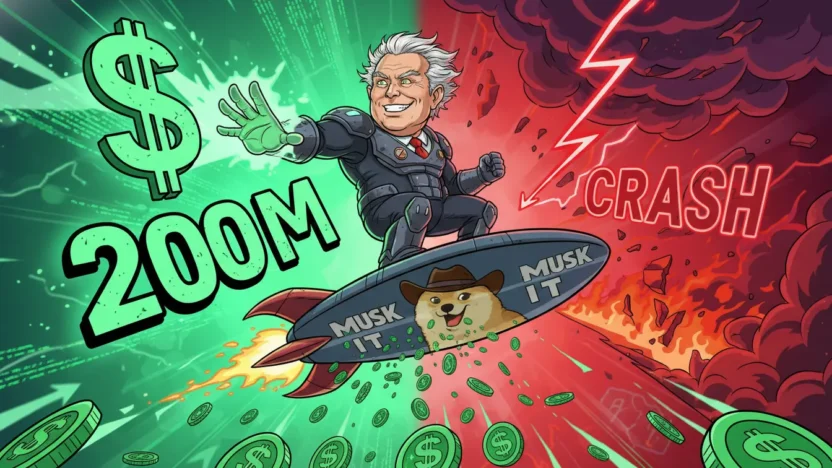
The Musk It meme coin has arrived — and with it, a fundraising ambition that reframes what celebrity-adjacent crypto launches can look like in 2025. Errol Musk, father of Elon Musk, is reportedly targeting a $200 million raise through his new token, a figure that immediately separates this project from the average influencer cash grab. The number is too large to dismiss and too loaded with family branding to ignore.
What makes this launch structurally interesting isn’t the token itself. It’s the psychological architecture around it. Errol Musk is not Elon Musk — yet the naming convention “Musk It” is designed to trigger the same associative reflex in retail investors who have already conditioned themselves to chase anything carrying that surname. That’s not accidental product design. That’s deliberate behavioral engineering.
The crypto market has seen this playbook before, but rarely with a $200 million target attached to a family member operating one degree removed from the world’s most influential crypto personality. The precedent being set here deserves scrutiny beyond the surface-level headlines.
Why the $200M Musk It target is a behavioral trap, not a business plan
Strip away the branding and what remains is a fundraising number that reveals the true audience for this launch. A $200 million target isn’t pitched at institutional desks or seasoned DeFi allocators. It’s a retail aspiration — a number large enough to generate legitimacy bias in casual investors who equate scale with credibility. This is a well-documented psychological pattern in speculative markets.
The mechanism works like this: when retail investors encounter a high-profile fundraise target, their default assumption is that professional validation preceded the public announcement. They assume due diligence happened upstream. In meme coin ecosystems, that assumption is almost never correct. The target itself becomes the marketing, functioning as social proof before a single dollar is raised.
What’s particularly revealing is the timing. Meme coin culture in 2025 has already cycled through multiple phases of euphoria and collapse. Investors who survived earlier meme coin seasons — from Dogecoin’s parabolic run to the Solana meme coin frenzy — carry scar tissue. Yet the Musk surname retains enough gravitational pull to potentially override that learned caution, which is exactly the behavioral gap this launch is exploiting. 💰
The name game: branding by proximity
There is a subtle but important distinction between endorsement and association. Elon Musk has not publicly backed “Musk It,” and no reporting suggests his involvement. Yet the token’s name structurally implies proximity to his influence. This creates a legally ambiguous but emotionally potent positioning that standard meme coins cannot replicate.
Retail participants will inevitably ask whether Elon knows about this project, whether the family connection provides insider access to Tesla or SpaceX announcements, or whether the Musk brand carries some form of implicit guarantee. None of these questions have affirmative answers — but the act of asking them keeps investor attention engaged long enough for early positioning to occur.
This is where the hidden market behavior becomes visible. In projects built on association rather than utility, early buyers don’t need the thesis to be true. They need other buyers to believe the thesis long enough to generate price appreciation. The $200 million target functions as an anchor that makes smaller individual investments feel proportionally reasonable. It’s a liquidity-gathering framing device.
What this signals about the current meme coin landscape
The emergence of “Musk It” reflects a maturation — and a corruption — of the meme coin launch cycle. First-generation meme coins like Dogecoin drew their value from genuine community humor and organic virality. Second-generation launches like Shiba Inu layered in tokenomics narratives. What’s happening now is the third evolution: celebrity genealogy as a fundraising instrument. The meme is no longer a joke. It’s a prospectus.
This shift matters for market structure because it changes who gets hurt. When meme coins rise and fall on community sentiment, losses are distributed across participants who understood the speculative nature of the bet. When launches use reputational proximity to simulate credibility, a different class of investor enters — one who believes they’re making a fundamentally sound decision rather than a speculative wager. That’s a more dangerous asymmetry.
The broader meme coin market has shown resilience through 2024 and into 2025, with total meme coin market capitalization continuing to attract disproportionate retail attention relative to fundamentally driven altcoins. Against that backdrop, a project carrying the Musk name — however tangentially — enters a market primed for exactly this kind of launch. The environment is permissive, and the brand is powerful. ⚠️
Historical parallel: celebrity launches that moved markets on name alone
The closest structural parallel isn’t a crypto event — it’s the pattern of celebrity-backed SPACs from 2020 to 2021. Blank-check companies fronted by recognizable names raised enormous capital quickly, with retail investors treating the celebrity association as a form of due diligence. Many collapsed within 12 to 18 months of their peak. The playbook was identical: high target, famous name, minimal underlying substance at launch.
In crypto, the velocity of this cycle is compressed dramatically. What took SPACs 18 months to unravel can happen in days or weeks when token liquidity is thin and sentiment shifts rapidly. This isn’t speculation about Musk It’s outcome specifically — it’s an observation about the structural category it inhabits.
What analysts should actually watch here
The fundraising figure of $200 million will serve as the primary signal. If Errol Musk’s project approaches that target, it confirms that surname-adjacent branding retains genuine retail mobilization power in the current cycle. That would be a meaningful data point for how future celebrity-adjacent projects are structured and priced.
If the raise significantly underperforms, it may indicate that meme coin market participants have become more discriminating — or that the one-degree-of-separation from Elon Musk is insufficient leverage without more direct involvement. Either outcome tells the market something important about the current appetite for narrative-driven crypto launches.
- Watch whether Elon Musk publicly distances himself from the project — any formal disavowal could accelerate retail caution
- Monitor listing announcements on major exchanges; institutional gating here would be revealing
- Track early wallet concentration as a signal of insider positioning versus genuine retail distribution
The real story inside the “Musk It” launch isn’t whether the token succeeds. It’s what the attempt reveals about who retail crypto investors still are in 2025 — and how effectively proximity to power can substitute for actual value in a market that continues to reward the architecture of belief over the substance beneath it.