
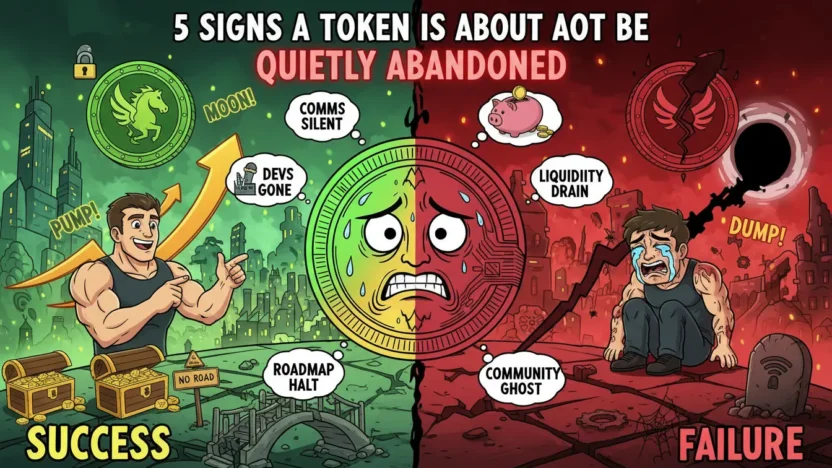
Most investors only recognize a quietly abandoned token after the damage is done — when liquidity has dried up, the team has gone silent, and the price chart looks like a staircase to zero. The problem is not that the signs were invisible. It is that they appeared weeks or months earlier, buried under surface-level activity designed to look like progress.
Token abandonment rarely happens with an announcement. There is no press release. The project simply decelerates — slowly enough that each individual signal seems explainable, but fast enough that by the time the pattern is undeniable, the exits are already crowded.
These five signs are not theories. They are patterns that repeat across market cycles, from small-cap experiments to mid-tier projects with millions in prior funding. Recognizing them early is not about being cynical — it is about reading what the structure of a project is actually communicating.
Why abandoned tokens are harder to spot than outright scams
A rug pull is violent and obvious in hindsight. Quiet abandonment is slower and more insidious. The team does not disappear overnight — they gradually reduce their involvement while maintaining just enough visible presence to prevent a panic sell.
This creates a specific problem for retail investors: the absence of bad news feels like good news. No negative updates get interpreted as stability. But in reality, silence is often the loudest signal a project can send.
The distinction matters because the defense against abandonment is different from the defense against fraud. You are not looking for deception — you are reading the energy and resource commitment of a team over time. That requires different tools and a longer attention span than most investors apply.
The five signs a token is about to be quietly abandoned
1. GitHub goes cold while marketing stays warm
Development activity on public repositories is one of the most honest signals available on any blockchain project. It cannot be faked at scale — code commits, pull requests, and contributor counts reflect real work. When that activity drops to near zero while the Twitter account keeps posting price updates and partnership announcements, the gap is telling you something critical.
The pattern typically looks like this: commit frequency falls by 80% or more over 60 to 90 days, but the project’s social channels maintain a steady stream of vague “ecosystem growth” content. This is not a coincidence — it is a deliberate maintenance of narrative while the underlying work quietly stops.
One well-documented example of this pattern is what happened across dozens of DeFi projects after the 2021 cycle peak. Projects that had been posting weekly development updates in Q1 2021 had completely inactive repositories by Q4, yet continued issuing token incentive announcements for months afterward. The token prices followed the code, not the tweets. ⚠️
2. Core team members leave without explanation
Founders and lead developers do not usually announce when they have mentally exited a project. They quietly update their LinkedIn profiles, start appearing in other projects’ Discord servers, and reduce their public presence. By the time the departure is officially acknowledged, it typically happened three months earlier.
Watch specifically for the disappearance of technical co-founders, not community managers or marketing leads. When the person responsible for the protocol architecture stops being visible — in governance forums, in developer calls, in documentation updates — the project has lost the person most capable of sustaining it.
Governance forums are often more revealing than social media here. A team that is genuinely building will be active in on-chain governance and proposal discussions. When those responses slow down or get delegated to junior community members, you are watching a leadership vacuum form in real time.
3. Token unlock schedules accelerate selling from insiders
On-chain data rarely lies. When insider wallets — identifiable through their vesting contract origins or early transaction history — begin moving tokens to exchanges at an accelerating pace, it is one of the clearest behavioral signals available. These are people with the most information about the project’s health, and they are voting with their wallets.
The nuance most retail investors miss is that not all insider selling looks the same. Gradual, scheduled sells aligned with public vesting timelines are normal and disclosed. What is not normal is selling that precedes announced unlock dates, or wallet activity that fragments large holdings across multiple addresses before moving to exchanges — a behavioral pattern consistent with someone trying to reduce visibility of their exit.
Tools like Nansen, Arkham, or even free on-chain explorers can surface this activity if you know what to look for. The pattern to watch for is consistent accumulation of stablecoins by early-stage wallets during periods of artificial price stability. 📉
4. Community engagement collapses in substance, not just volume
A dying project often maintains raw engagement numbers longer than you would expect. Bots, paid moderators, and loyal early community members keep the Discord populated and the Telegram active. But the quality of engagement changes dramatically before the quantity falls.
Specifically, watch for the disappearance of substantive technical questions in developer channels. In healthy projects, builders ask hard questions about integration, edge cases, and roadmap dependencies. When those conversations dry up and get replaced with price speculation and meme sharing, the builder community has already left — even if the hype community remains.
This is not about being dismissive of community culture. It is about understanding that serious developer communities are a leading indicator of project survival. When they go, the economic activity that justifies a token’s value goes with them.
5. The roadmap becomes permanently future-tense
Every ambitious project has a roadmap. The difference between a living project and one being abandoned is what happens when milestones are missed. In a functioning team, missed milestones trigger transparent post-mortems, revised timelines with specific technical explanations, and visible course correction. In an abandoned project, they trigger vague reframings and new, distant goalposts.
The specific linguistic shift to watch for is the move from concrete deliverables (“mainnet launch Q2, audited by Firm X”) to abstract positioning (“we are building toward a long-term ecosystem vision”). This is not optimism — it is the language of a team that has stopped committing to accountability.
Watch the version history of whitepapers and documentation. Projects that are actively building update their technical documentation frequently and visibly. Projects that have quietly stalled often leave documentation frozen at an early version while the roadmap page undergoes cosmetic refreshes with no real content change.
What most investors miss about these signals
Each of these signs on its own can have an innocent explanation. A developer takes a leave. GitHub restructures to a private repo for a legitimate security reason. The roadmap adjusts after real technical setbacks. The signal is not any single indicator — it is the convergence of multiple signs within the same 60 to 90 day window.
The structural reality of token abandonment is that it usually begins as rational economic behavior by insiders who see diminishing returns before anyone else does. Understanding this reframes your analysis entirely. You are not looking for bad actors necessarily — you are looking for the moment when the people closest to the project have quietly updated their own probability estimates.
When two or more of these signals appear simultaneously — especially GitHub silence combined with insider selling — the burden of proof should shift. The question is no longer “is something wrong?” It is “what specifically justifies continued conviction here?”
Frequently asked questions
Can a token recover after showing these abandonment signs?
Occasionally, yes — but recovery almost always requires a demonstrable change in team composition or a credible external developer picking up the project. Without that concrete signal, historical patterns suggest that a token showing three or more of these signs within a short window rarely sustains long-term value. The exceptions tend to involve projects with genuinely embedded infrastructure that third parties depend on.
Is low trading volume always a sign of abandonment?
Not on its own. Many legitimate tokens with narrow utility have persistently low volume without being abandoned. Low volume becomes meaningful as an abandonment signal only when it occurs alongside declining developer activity or team visibility. Volume is a lagging indicator — it confirms what other signals have already suggested.
How do I check GitHub activity for a token I hold?
Most legitimate projects list their repository in their documentation or official website. On GitHub, you can view the “Insights” tab of any public repo to see commit frequency, contributor counts, and activity timelines. A healthy project will show consistent, multi-contributor activity — not just a single developer making sporadic cosmetic changes.
Do these signs apply to NFT projects and DAOs, not just tokens?
The same structural patterns apply, though the specific metrics shift. For NFTs, watch for the disappearance of the creative or technical lead and a freeze in trait or contract updates. For DAOs, watch for governance participation rates and proposal quality — when only one or two wallets are submitting governance proposals, the distributed ownership thesis has already collapsed in practice.
What is the difference between a quietly abandoned token and a slow-burn project?
A slow-burn project typically has transparent, consistent communication about its deliberately measured pace — and its on-chain development activity, however modest, continues without interruption. A quietly abandoned token has a gap between its public narrative and its actual activity. The communication may sound similar, but the underlying evidence diverges sharply when you check the repositories, the governance forums, and the insider wallets.