
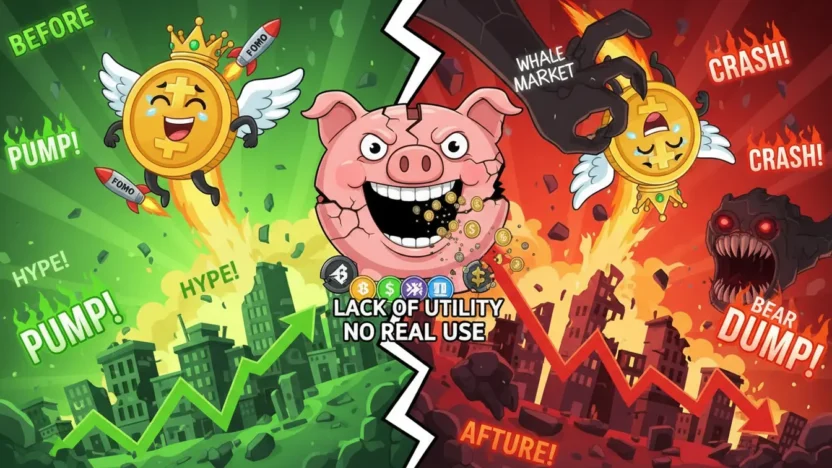
Most people assume altcoins fail to recover from a crash because the market simply moves on. That assumption misses the real structural reason almost entirely. The real reason most altcoins never recover from a crash is a combination of permanent capital destruction, broken tokenomics, and the disappearance of the one thing that made them move in the first place: a narrative.
When a token drops 90%, retail investors often wait for a bounce that never comes. They’re applying stock market logic to an entirely different asset class. Stocks represent ownership in cash-generating businesses. Most altcoins represent something far more fragile — a story, a community, and a speculative premium that evaporates when sentiment shifts.
The answer isn’t just “bear markets are tough.” It’s that the conditions that created an altcoin’s price in the first place rarely reassemble. Once liquidity drains, teams dissolve, and attention moves elsewhere, most projects are structurally incapable of returning — regardless of price level.
Why the first crash is often the last chapter
There’s a pattern that repeats across every market cycle. An altcoin rises on a combination of speculative inflows, social momentum, and a compelling use case that hasn’t been tested yet. Then a macro shock, a scandal, or simple rotation triggers a selloff. What follows isn’t just a price decline — it’s an unraveling of every condition that made the price possible.
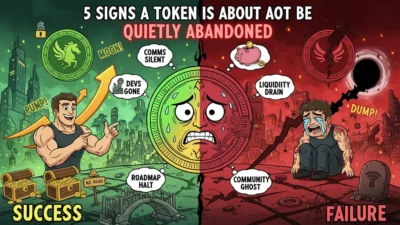
📉 Consider what happened to the 2017–2018 generation of ICO tokens. Thousands of projects raised capital at multimillion-dollar valuations with nothing more than whitepapers. When Bitcoin crashed in early 2018, altcoins followed — but most never participated in the 2020–2021 bull run at all. They weren’t just down. They were effectively dead, with ghost Telegram groups and developers long gone.
This pattern isn’t a coincidence. It reflects a structural reality: altcoin prices are sustained by ongoing participation, not by intrinsic value. The moment participation stops compounding, the floor has no support mechanism.
The liquidity illusion most holders fall for
During a bull market, thin altcoins can appear highly liquid. Prices move smoothly. Buy orders fill instantly. This creates the illusion that exit liquidity will always be available. It won’t be.
When a crash begins, market makers withdraw. Spreads widen dramatically. Order books become shallow. A token that seemed easy to sell at $1.00 becomes nearly impossible to exit at $0.10 without moving the price further against you. This is liquidity fragmentation, and it accelerates the decline far beyond what fundamentals would justify.
The deeper problem is that the liquidity that existed during the bull phase was largely circular — new buyers funded existing holders’ exits. Once new buyer flow stops, the whole structure collapses. There’s no fundamental floor to catch it.
Token supply doesn’t wait for recovery
Even if sentiment eventually turns, most altcoins face a second structural problem: continuous token emissions. Staking rewards, team vesting schedules, ecosystem grants, and liquidity mining programs keep printing new supply throughout the bear market.
A token that crashed from $5 to $0.20 might theoretically look cheap. But if 40% of the total supply is still locked in team and investor wallets with upcoming unlock dates, every attempted recovery becomes a sell wall. The holders who want to sell are simply waiting for price to recover enough to minimize their losses — and that selling pressure prevents the recovery they’re waiting for.
This is one of the most reliable structural traps in crypto. The very mechanics designed to fund a project’s development become the mechanism that prevents its price from recovering.
What actually drives altcoin recovery — and why it’s rare
Genuine altcoin recoveries do happen. But they share a specific set of conditions that most projects simply don’t meet after a crash. Understanding what separates the survivors from the permanent casualties is more useful than hoping for a broad market tide to lift everything.
Narratives don’t recycle, they rotate
Crypto markets run on narratives — DeFi summer, NFT mania, Layer 2 scaling, AI tokens. Each cycle amplifies a new theme. A token associated with a previous cycle’s narrative rarely becomes the focal point of the next one. Markets move forward, not backward.
This is why a 2021 DeFi token sitting at 95% below its all-time high isn’t necessarily a “value play.” Its relevance was tied to a specific moment in time. The capital that will flow into the next cycle will chase the new narrative — not relitigate the old one.
Projects that survive crashes do so because they manage to embed themselves in the next narrative, not because they held on long enough for their old one to return. That transition requires active development, funding, and community — all things that deteriorate during extended bear markets.
Developer activity is the signal most price charts hide
Price charts show you what already happened. GitHub commit history shows you whether anyone is still building. The most reliable leading indicator of whether an altcoin has any recovery potential is sustained, authentic development activity during the bear phase.
Projects where core contributors stay active, ship updates, and maintain community engagement despite low prices have demonstrated something rare: conviction that isn’t purely financial. Those teams tend to be better positioned when liquidity returns. Teams that go quiet after a crash are signaling that their participation was conditional on price appreciation — which tells you everything.
The misconception that keeps investors holding the wrong coins
⚠️ The most damaging belief in crypto is that a large percentage decline automatically creates value. “It’s down 95% — how much lower can it go?” is a question that has destroyed more portfolios than any other single thought pattern.
An asset at $0.05 that was once $1.00 has not become five cents worth of value. It has become evidence that the market assigned $1.00 of speculative premium to something, and then removed it. The $0.05 is not a floor — it’s simply the latest price. It can go to zero. Many do.
Survivorship bias distorts this further. Investors remember the altcoins that recovered spectacularly. They forget the thousands that quietly went to zero, got delisted, or became permanently illiquid. The selection of memorable examples makes recovery feel more common than it statistically is.
Real value in any asset requires a mechanism for generating demand that isn’t purely speculative. For most altcoins, that mechanism was never built — and a crash simply exposes what was always true underneath the momentum.
What to watch for instead of waiting
The productive question after a crash isn’t “when will this recover?” It’s “does this project still have the structural inputs required for a recovery?” Those inputs are specific and observable.
- Active core development — commits, protocol upgrades, and shipped product during the bear phase
- Manageable token unlock schedule — no major supply overhang suppressing price during recovery attempts
- Alignment with an emerging narrative — not just the old use case, but relevance to where capital is rotating next
- Real user activity — on-chain transactions, protocol revenue, or genuine ecosystem growth independent of price
Projects that check these boxes are rare. That rarity is itself the signal. If most altcoins met these criteria, recovery rates would be far higher than history suggests they are.
The hard truth is that most altcoin crashes are not temporary setbacks — they are permanent capital events dressed as corrections. The structural conditions that made recovery possible simply don’t reassemble. Recognizing that early isn’t pessimism. It’s the discipline that separates investors who survive multiple cycles from those who don’t.
Frequently asked questions
Are there any on-chain metrics that signal an altcoin might actually recover?
Sustained growth in active wallet addresses, consistent protocol revenue, and rising developer commits during a bear market are the strongest structural signals. Price alone tells you nothing about recovery potential. These metrics reveal whether genuine utility demand exists independent of speculation.
How long does it typically take for a recovering altcoin to return to its previous high?
The honest answer is that most never do — and those that do often take multiple years and require alignment with a new market narrative. Waiting for a return to a previous all-time high as an exit strategy is one of the most common and costly mistakes in crypto investing.
Does being listed on major exchanges like Coinbase or Binance protect an altcoin from permanent decline?
Exchange listings provide short-term liquidity and visibility, but they don’t create fundamental demand. Exchanges also delist tokens that lose trading volume — which removes even the liquidity advantage. A major exchange listing is a distribution channel, not a value guarantee.
Is there a meaningful difference between a token going to zero and staying at a very low price indefinitely?
Functionally, they are nearly identical outcomes for most investors. A token stuck at 1–2% of its all-time high with no volume is effectively illiquid — you cannot exit without moving the price further against yourself. The capital is gone whether the price shows $0.00 or $0.003.
What role does the founding team play in whether a token recovers?
The founding team is arguably the single most decisive factor. A credible, active team can reposition a project for a new narrative, secure new partnerships, and maintain developer momentum through a bear market. When teams dissolve or go silent, the project’s fate is essentially decided — no community or community manager can substitute for core technical leadership.