
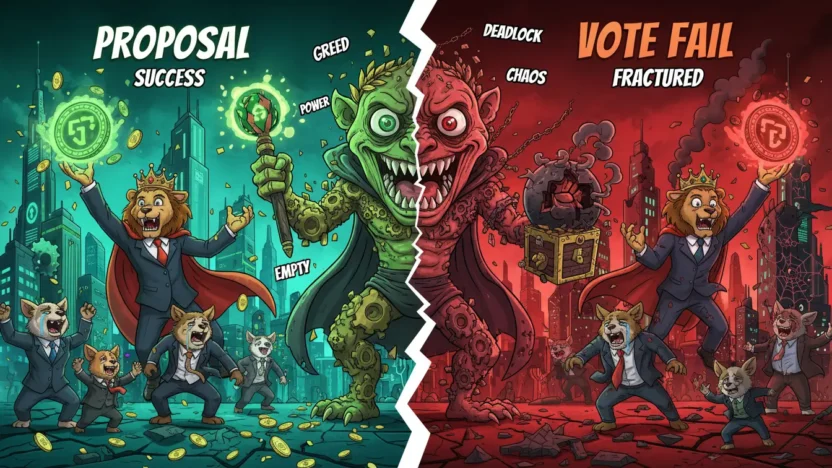
The problem with governance tokens nobody admits is not that they fail to give holders power — it is that the power they offer is structurally designed to be exercised by almost nobody. Most projects launch governance tokens with genuine intentions around decentralization. What actually emerges is a system that mimics shareholder democracy while behaving nothing like it.
The core issue is concentration. A small number of wallets — often early investors, founding teams, and venture funds — hold enough tokens to determine every meaningful vote. Retail holders participate in the theater of governance without influencing its outcomes.
This is not a fringe critique. It is a pattern that has repeated across protocols, market cycles, and blockchain ecosystems. The mechanism is real. The decentralization, in most cases, is not.
- TL;DR: Governance tokens promise decentralized control but structurally concentrate power among early insiders, making retail participation largely symbolic.
- Token-weighted voting means wealth equals votes — the same inequality governance claims to solve is baked into the design.
- Low participation rates and proposal complexity allow concentrated holders to pass votes with minimal opposition.
- Watch for token distribution at launch — it reveals more about governance reality than any whitepaper promise.
Why token-weighted voting is not what decentralization looks like
The foundational mechanic of most governance systems is simple: one token equals one vote. This sounds fair until you examine who holds the tokens.
In traditional finance, shareholder voting operates on the same principle. Institutional investors — BlackRock, Vanguard, sovereign wealth funds — routinely outvote retail shareholders on corporate resolutions. The difference is that traditional markets disclose this concentration clearly. Most crypto governance systems do not foreground it.
Voter apathy compounds the problem. Participation rates in on-chain governance are consistently low, often below 10% of eligible token supply. When a proposal requires a quorum of 4% and only 6% of tokens vote, a single large holder can determine the result while the outcome appears democratically legitimate.
The delegation trap
Some protocols introduced delegated voting as a solution. Holders delegate their voting power to representatives who vote on their behalf. This mirrors representative democracy, at least in theory.
In practice, delegation concentrates power further. Most holders never delegate. Those who do tend to delegate to prominent community figures or — critically — to the protocol’s own team. The result is that founders end up with delegated authority on top of their own token holdings.
Compound Finance’s governance system is an instructive example. Shortly after launching its COMP token, a handful of addresses — largely venture capital firms and founding team wallets — controlled enough delegated votes to pass or block proposals unilaterally. The governance forum was active. Retail holders were vocal. The votes were decided before most discussions concluded.
Quorum theater and proposal fatigue
Governance participation requires time, technical literacy, and motivation. Most retail holders have none of these in quantity. Proposals are often long, technical, and interconnected with protocol economics that require deep context to evaluate.
This creates proposal fatigue — a dynamic where only the most engaged (and typically the most financially invested) actors participate regularly. Over time, governance becomes a conversation between insiders, with retail holders as a passive audience.
Here is the layer most analysis skips entirely. Governance tokens are frequently issued as liquidity mining rewards or yield incentives. This means the people accumulating the most tokens are not necessarily those most aligned with the protocol’s long-term health.
Yield farmers acquire tokens to capture emissions. They vote — if they vote at all — in ways that preserve or increase yield. This incentivizes governance decisions that prioritize short-term liquidity over sustainable protocol design.
The structural irony is precise. The mechanism designed to align holders with the protocol’s future actively attracts participants whose primary goal is extraction.
When governance becomes a vector for attack
The Beanstalk Protocol attack in 2022 demonstrated what happens when governance mechanics are weaponized. An attacker used a flash loan to acquire enough governance tokens within a single transaction to pass a malicious proposal. The vote executed. Roughly $182 million was drained.
This was not a smart contract bug in the traditional sense. The governance mechanism worked exactly as designed. The design was the vulnerability.
Governance model Core mechanic Key vulnerability Real example Token-weighted voting 1 token = 1 vote Whale dominance, flash loan attacks Beanstalk, Compound Delegated voting Holders assign votes to delegates Delegation concentration, founder control Compound, Uniswap Quadratic voting Cost of votes scales quadratically Sybil attacks via multiple wallets Gitcoin grants Multisig governance Named key holders approve changes Centralization, key compromise Early Uniswap, most new protocols
Risks that governance token holders routinely underestimate
⚠️ Beyond vote concentration and protocol attacks, governance token holders face risks that are structural and persistent across every market cycle.
Regulatory classification risk
Regulatory exposure is arguably the most underappreciated risk. If a governance token is classified as a security by a national regulator — as the SEC has argued in multiple enforcement actions — holders face retroactive compliance exposure. The token’s governance utility does not insulate it from securities law.
This is not theoretical. Tokens with fee-sharing mechanics and governance rights sit at the precise intersection regulators examine most closely.
Governance as a liability shield
Some founding teams use governance token launches strategically. By distributing tokens, they transfer formal decision-making authority to a decentralized community. If the protocol harms users, legal responsibility becomes harder to assign.
This is not necessarily malicious. But it means holders may inherit governance responsibility without holding operational control. They vote on parameters they cannot enforce and bear reputational risk they cannot manage.
Token dilution through governance itself
Many protocols allow governance to approve new token emissions. A holder voting in every proposal can still find their ownership percentage diluted if a whale coalition votes to expand supply. Inflation risk in governance token systems is often governed by the same concentrated actors who benefit most from new emissions.
Disclaimer
This article is intended for educational purposes only and does not constitute financial advice, investment recommendations, or legal guidance. The cryptocurrency market is highly volatile and speculative. Any decision involving digital assets carries substantial risk of loss. Always conduct independent research and consult a qualified financial professional before making investment decisions.
What a governance token’s launch distribution tells you that the whitepaper won’t
After observing multiple governance failures, one signal stands out as predictive: the initial token allocation. Projects that reserve more than 40% of supply for team, advisors, and private investors at launch are structurally unlikely to achieve meaningful decentralization — regardless of vesting schedules or stated intentions.
Vesting unlocks over time, but governance happens continuously. In the critical early period when protocol direction is established, insiders hold the votes. By the time retail holders gain meaningful supply, the protocol’s core decisions have already been made.
The question worth asking before holding any governance token is not “what can I vote on?” It is “who actually decides?” Those two questions rarely have the same answer.
Frequently asked questions
Can governance tokens ever provide real decentralized control?
The short answer is yes, but only under specific conditions. Protocols with wide initial distribution, high participation rates, and time-locks on proposals have demonstrated more genuine decentralization. These conditions are rare and require deliberate design choices from launch.
Are governance tokens considered securities?
The short answer is it depends on the jurisdiction and token design. Tokens with profit-sharing or fee distribution features face stronger regulatory scrutiny. No universal legal classification exists, but regulatory agencies in the US and EU have increasingly applied securities frameworks to governance tokens with economic rights.
What is the difference between governance tokens and utility tokens?
The short answer is that governance tokens grant voting rights over a protocol, while utility tokens grant access to a service. In practice, many tokens combine both functions, which complicates both their use and their regulatory classification.
Why do most governance token holders never vote?
The short answer is a combination of apathy, complexity, and rational disengagement. When a single holder’s votes cannot meaningfully influence outcomes, participation carries a cost — time and gas fees — without a realistic reward. This is a structural disincentive baked into most governance designs.
What is a flash loan governance attack?
The short answer is an exploit where an attacker borrows a large token amount within a single transaction to meet a governance quorum, passes a malicious proposal, and repays the loan — all in one block. The Beanstalk attack is the most documented example of this mechanic executed at scale.