

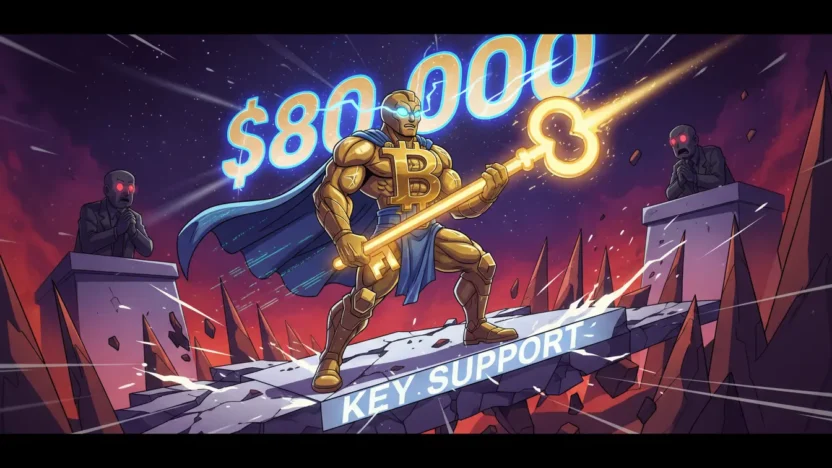
Bitcoin is holding a critical support zone as traders lock their attention on the $80,000 price level — a threshold that could define the market’s next major directional move. The tension building beneath the surface is palpable. Every session close feels like a vote cast in a deeply contested election.
Price action has stabilized, but stability in crypto rarely signals safety. More often, it signals accumulation — or distribution. The question traders are asking right now is simple: which side is doing the work?
The broader market is watching closely. Bitcoin’s behavior at this juncture carries outsized implications for altcoins, derivatives markets, and overall sentiment heading into the next phase of this cycle.
Why $80,000 is the line Bitcoin bulls cannot afford to lose
Support levels in crypto are rarely just numbers. They represent the collective memory of where buyers last stepped in with conviction. $80,000 sits at the confluence of several structural reference points that make it uniquely significant. 📊
Historically, round numbers act as psychological magnets. They attract stop-losses, limit orders, and media attention simultaneously. When Bitcoin orbits a level like $80,000, it creates a self-reinforcing tension. Both bulls and bears are watching — and both are positioned accordingly.
The architecture of support beneath current price
What makes this level structurally important is not just the price itself. It’s the layered demand that appears to exist directly below it. Traders on major platforms including Binance and Coinbase have been observed placing significant bids in this zone.
Liquidity clustering around a key level often creates a gravitational pull. Price tends to revisit areas of dense order flow. That’s not a prediction — it’s market mechanics at work.
Key levels traders are monitoring right now
- $80,000 — primary psychological and structural support
- $78,500 — secondary demand zone where previous wicks found buyers
- $83,000–$85,000 — immediate resistance range bulls must reclaim
- $88,000 — the level that would confirm a bullish structural shift
A clean hold above $80,000 with rising volume would signal that demand is genuine. A breakdown — especially on elevated volume — would tell a very different story. The setup is binary in nature, and that’s what makes this moment so consequential.
Volume and momentum: the contradiction worth noting ⚠️
Here’s where the story gets more complex. Price has stabilized, but trading volume has not surged in a way that typically accompanies strong accumulation. This creates a notable contradiction. Stable price plus weak volume often means the market is waiting — not committing.
On Bybit and Kraken, funding rates have remained relatively neutral. This suggests neither extreme greed nor extreme fear is dominating the derivatives market. That neutrality can flip quickly, however, once a catalyst emerges.
The forces underneath the price: what the chart isn’t telling you
Surface-level price action can be deceiving. Understanding what’s happening beneath the chart is often more valuable than reading the candles themselves. 🔥
Sentiment metrics paint a cautious picture. The Fear and Greed Index has been oscillating in the fear zone, reflecting a market that hasn’t yet found its emotional footing. Fear-dominant environments can precede explosive recoveries — but they can also precede capitulation events.
Macro pressure remains a background variable
Bitcoin does not exist in a vacuum. The broader financial environment continues to shape risk appetite. Uncertainty around Federal Reserve policy has kept institutional participants in a state of measured caution.
When the DXY strengthens or equity markets show stress signals, Bitcoin tends to absorb downside pressure disproportionately. Any further macro deterioration could test the resolve of buyers clustered near $80,000. Conversely, a softening macro tone would act as rocket fuel for a recovery trade.
On-chain signals worth tracking closely
Long-term holders have not shown meaningful distribution at current levels. This is a meaningful signal. When experienced, high-conviction holders resist selling, it typically reflects a belief that current prices do not represent fair value. 💰
Short-term holder behavior, however, is more fragile. This cohort tends to sell into weakness and buy into strength — amplifying moves in both directions. If price dips toward the $78,500 zone, short-term holder panic could accelerate the move.
- Long-term holder supply: largely undisturbed — bullish signal
- Short-term holder sensitivity: elevated — risk of volatility
- Exchange inflows: moderate — not yet alarming
- Funding rates: neutral — no dominant directional bias
Three scenarios the market must prepare for
No single outcome is guaranteed. The intellectually honest approach is to map the realistic scenarios and define what data would confirm each. Here is how the next move could unfold. 📈
Scenario one: bulls reclaim momentum
Bitcoin holds $80,000 decisively and pushes through the $83,000–$85,000 resistance band on rising volume. This would trigger a wave of short liquidations across Binance and Bybit. The squeeze could propel price rapidly toward $88,000 and beyond.
Scenario two: support fails and sellers take control
A daily close below $80,000 with conviction would shift the technical structure bearish in the short term. The next meaningful support area would be tested near $78,500. A failure there opens a deeper corrective move that could rattle sentiment significantly.
Scenario three: range-bound grinding continues
Bitcoin remains trapped between $80,000 and $84,000 as the market waits for a macro catalyst. This is the scenario that exhausts impatient traders and rewards those positioned for a breakout. Time in range can compress volatility — until it can’t. The explosion, when it comes, tends to be violent in either direction.
The most important variable to watch in the coming sessions is daily close behavior relative to $80,000. Closes, not wicks, define structure. If Bitcoin continues printing closes above this level, the bull case retains its foundation. If that changes, the calculus shifts entirely. This is the moment to watch the data — not the noise.