
Trump’s meme coin dinner and Robinhood’s crypto disappointment landed in the same week — and the contrast couldn’t be more telling. One story is about spectacle. The other is about substance. Together, they reveal something deeper about where crypto confidence actually sits right now.
The market doesn’t always move on fundamentals. Sometimes it moves on narrative gravity. This week handed traders two very different narratives to process simultaneously.
While headlines celebrated a presidential dinner for meme coin holders, institutional players quietly digested Robinhood’s underwhelming crypto showing. The disconnect between retail theater and platform execution is becoming harder to ignore.
When the president hosts meme coin winners, the signal is cultural — not technical
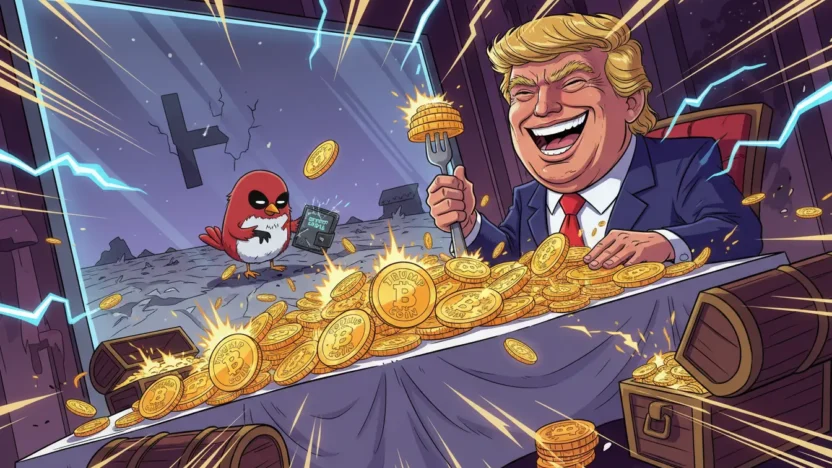
Donald Trump hosted a dinner for top holders of his official meme coin. The event was real. The symbolism was louder than any price chart. 🎭
This isn’t just a novelty story. A sitting former president — and current political force — actively rewarding speculative token holders sends a structural message. It normalizes meme coins as participation vehicles in political ecosystems.
That’s a shift worth tracking. Meme coins have historically lived and died on viral momentum. Tying one to presidential access creates a new kind of demand floor — social capital, not just speculation.
What the dinner actually signals about retail appetite
Retail hasn’t left the building. The dinner proved that meme coin communities remain deeply engaged, even in a market that’s seen significant cooling from peak euphoria. Participation was real. Enthusiasm was genuine.
But there’s a contradiction embedded here. The tokens rewarding dinner access are not infrastructure plays. They’re attention plays. And attention, unlike liquidity, evaporates fast.
The hidden risk is that events like this pull retail focus toward speculative assets precisely when the market needs conviction in higher-quality projects. Spectacle competes with substance for the same capital pool.
The political tokenization trend isn’t slowing down
Trump’s meme coin isn’t an isolated experiment anymore. It’s a proof of concept for politically branded tokens. Whether that concept scales into something durable is the real question investors should be asking.
For now, the dinner functions as marketing. It generates social proof. It keeps the token relevant in news cycles far beyond crypto-native media. That’s not nothing — but it’s also not a roadmap.
Robinhood’s crypto disappointment is the signal institutions are quietly watching
While the meme coin dinner dominated headlines, Robinhood’s crypto results drew a different kind of attention. The platform disappointed — and in a market hungry for mainstream adoption signals, that matters more than it might appear. 📉
Robinhood has been one of the clearest proxies for retail crypto engagement in the United States. When it underperforms expectations, analysts treat it as a thermometer for broader retail sentiment. This week, the temperature dropped.
Why platform-level underperformance cuts deeper than a single earnings miss
Robinhood’s crypto segment disappointing isn’t just a company story. It reflects the gap between narrative enthusiasm and actual trading volume. Headlines say crypto is booming. The platform data tells a more complex story.
Retail traders engage in waves. Between those waves, platforms feel the drag. Robinhood’s crypto business is highly sensitive to those cycles — more so than exchanges like Binance, Coinbase, or Kraken with deeper institutional rails underneath them.
The implication is that the current market phase may be less retail-driven than the meme coin dinner narrative suggests. Retail attention is fragmented. It hasn’t fully converted back into sustained trading activity.
This is the contradiction the week handed us. Enormous social energy around a meme coin dinner. Muted platform performance from a retail-facing crypto broker. These two data points don’t rhyme.
One explanation: engagement is happening at the narrative layer, not the transaction layer. People are watching, reacting, and sharing — but not necessarily buying or trading at scale. That’s a different kind of market signal entirely.
Platforms live and die on transaction volume. Social buzz without conversion is noise. And right now, the noise-to-signal ratio in crypto is running unusually high.
What the week’s contradictions tell serious traders about what’s actually next
Two stories. Two wildly different implications. The smart money reads both simultaneously rather than choosing a narrative. 🔍
The meme coin dinner tells you retail sentiment hasn’t collapsed. The Robinhood disappointment tells you retail activity hasn’t recovered. That gap — between sentiment and action — is the space where the next real market move will likely originate.
Watch for whether retail trading volumes on major platforms begin to converge with the social enthusiasm visible in meme coin ecosystems. If they do, it signals a genuine re-engagement phase. If they don’t, the spectacle remains disconnected from market structure.
The other signal worth tracking is whether politically branded tokens begin attracting regulatory scrutiny at a louder volume. Events like a presidential meme coin dinner don’t go unnoticed in Washington or Brussels. The regulatory response — or deliberate silence — will shape how this category matures.
This week wasn’t about price action. It was about the architecture of attention in a market still searching for its next genuine catalyst. The dinner was loud. The disappointment was quiet. The truth, as always, lives somewhere between the two.