
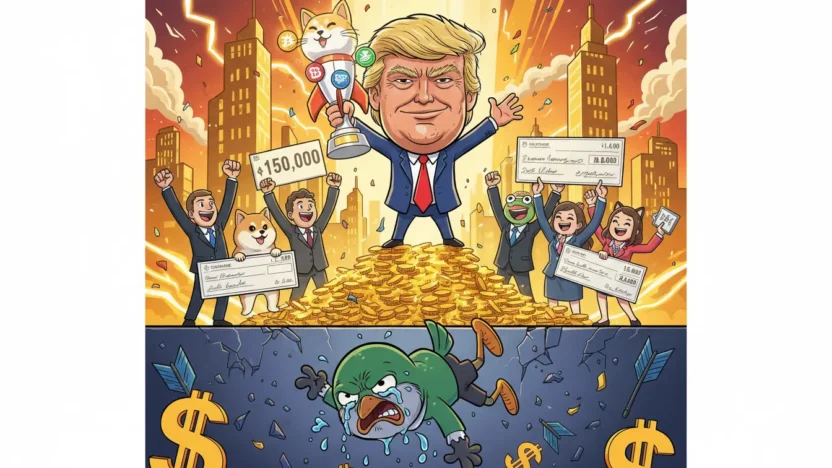
Trump hosts meme coin winners in a move that blurs the line between political spectacle and crypto legitimacy. This isn’t just a dinner invitation — it’s a signal that political capital and speculative tokens are now openly intertwined at the highest levels of power.
Meanwhile, Robinhood’s latest performance disappointed markets, raising deeper questions about whether retail-facing platforms are losing their grip on the next wave of crypto participants. The contrast between these two stories tells us something important about where crypto’s center of gravity is shifting.
One headline celebrates a meme coin ecosystem with direct White House adjacency. The other reveals cracks in a platform that once defined retail crypto access. Together, they sketch a market in structural transition — not just in price, but in power dynamics.
Trump hosts meme coin winners: when politics becomes the biggest liquidity event
The dinner hosted by Donald Trump for top holders of his meme coin is unlike anything crypto has seen before. 🎯 A sitting former president — and now current president — using a speculative token to curate an exclusive guest list is genuinely unprecedented.
This isn’t just about the meme coin itself. It’s about what it represents as a financial instrument tied to political access. Holding tokens now potentially unlocks real-world proximity to political influence.
That structural dynamic creates a demand floor that has nothing to do with utility or technology. It has everything to do with status, exclusivity, and narrative. These are powerful market forces that traditional analysts consistently underestimate.
Why meme coins with political backing break conventional valuation models
Standard crypto analysis looks at tokenomics, liquidity depth, and developer activity. None of those frameworks adequately capture what a presidential endorsement does to speculative demand.
When the asset becomes a ticket to something exclusive, its floor price is no longer purely speculative. It’s partially social and reputational. That’s a different kind of value — and a dangerous one to ignore in your market model.
The risk, of course, cuts both ways. Political fortunes shift. Narrative cycles end. And meme coins with no underlying utility remain structurally fragile once the media cycle moves on.
Here’s the tension worth naming clearly. Crypto was built on decentralization and resistance to centralized power. A meme coin that grants access to a political figure is arguably the most centralized utility imaginable.
Yet the market doesn’t always punish irony. It rewards narrative momentum. And right now, the narrative around politically adjacent tokens is generating volume, attention, and new participants — however uncomfortable that makes crypto purists.
Robinhood falls short: the retail gateway is losing the plot
Robinhood’s disappointing results land at a particularly awkward moment. The platform built its identity on democratizing finance — crypto included. But recent performance suggests that identity is struggling to translate into sustainable growth. 📉
The crypto market has evolved rapidly. Users who started on Robinhood have migrated toward platforms offering deeper liquidity, broader asset selection, and more sophisticated tooling. Binance, Coinbase, Kraken, and Bybit are capturing the more engaged trader.
Robinhood, by contrast, still skews toward the casual, infrequent participant. That demographic is notoriously fickle — highly active in bull market peaks, largely absent everywhere else.
What Robinhood’s numbers actually reveal about retail sentiment
When a retail-first platform underperforms during a period of general crypto optimism, it’s worth asking a direct question. Is retail actually as engaged as the meme coin narrative suggests?
The answer appears more nuanced. Retail participation is highly fragmented right now. Meme coin speculation pulls in one segment. Long-term Bitcoin holders represent another. But the casual mid-range trader — Robinhood’s core user — may still be sitting on the sidelines.
That’s a meaningful data point for assessing the true breadth of this bull cycle. Headline prices can mask thin participation layers underneath.
The platform evolution problem no one wants to address
Robinhood faces a structural challenge that goes beyond one bad quarter. The crypto user base it originally captured has matured. Those users now want perpetual futures, on-chain access, staking yields, and advanced order types.
Robinhood has made moves in this direction. But it remains behind the curve relative to global competitors. The gap between its product offering and user expectations appears to be widening — not narrowing.
What these two stories reveal about crypto’s evolving power map
Read together, these narratives point to a market where influence flows in unexpected directions. Political figures can now launch tokens that attract serious capital. Meanwhile, traditional fintech gatekeepers are struggling to hold audience share.
The structural implication is clear. Crypto’s next phase won’t be dominated by the platforms that made it accessible a decade ago. It will be shaped by whoever controls narrative, community, and — increasingly — political proximity.
That’s an uncomfortable truth for those who believe crypto’s value should be purely meritocratic and technology-driven. But markets have never been purely meritocratic. They’ve always followed power and story.
Watch how Robinhood responds in the next two quarters — product evolution or continued lag will be telling. And watch whether the Trump meme coin maintains volume once the dinner narrative fades. If it holds, political tokens may be more durable than critics expect. If it collapses, it becomes a textbook case study in narrative-driven speculation with no structural floor.