
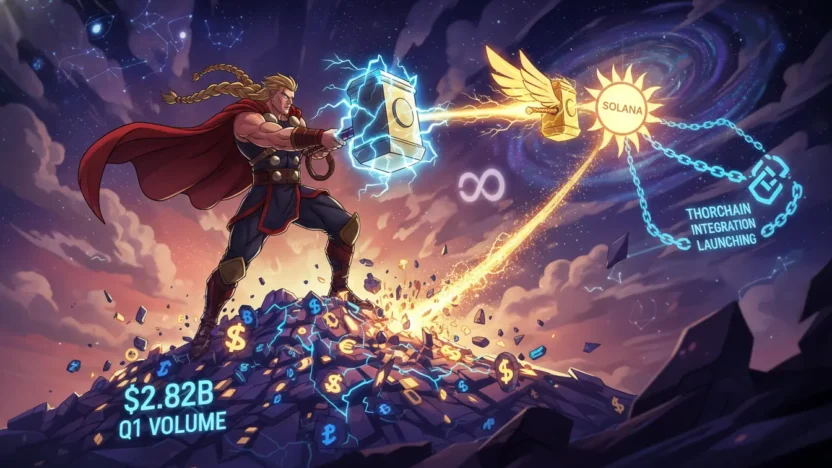
THORChain just posted $2.82 billion in Q1 volume — and the timing of that number is everything. It didn’t arrive quietly. It landed alongside one of the protocol’s most strategically significant moves yet: a live integration with Solana.
For a protocol that spent much of 2024 navigating debt restructuring and community turbulence, this is a striking reversal of narrative. The question worth asking isn’t just how THORChain got here. It’s what this combination of volume recovery and chain expansion actually signals beneath the surface.
Cross-chain liquidity infrastructure has always been the unglamorous backbone of DeFi. But unglamorous doesn’t mean unimportant. In fact, the protocols that quietly solve interoperability tend to become structurally irreplaceable — and THORChain is making its case right now.
THORChain’s Solana integration is the move that reframes everything
Adding Solana isn’t just a feature update. It’s a deliberate play into the highest-velocity ecosystem in crypto right now. Solana’s user base is large, active, and increasingly hungry for native cross-chain access without wrapping or bridging compromises.
THORChain’s model — native asset swaps with no synthetic intermediaries — is architecturally well-suited to capture that demand. Users can move real assets across chains without trusting a custodian or minting a proxy token. That distinction matters more than most headlines acknowledge.
Solana’s DeFi ecosystem has matured rapidly. Protocols like Jupiter and Raydium dominate intra-chain volume. But cross-chain liquidity between Solana and ecosystems like Bitcoin or Ethereum has remained a friction point. THORChain is positioning itself directly in that gap.
Why this integration could unlock a different class of volume
The $2.82 billion Q1 figure reflects existing chain support — primarily Bitcoin, Ethereum, and compatible L1s. Solana hasn’t been part of that equation until now. That means the volume baseline being reported is essentially pre-Solana.
If Solana users begin routing cross-chain swaps through THORChain at even a fraction of the chain’s native trading activity, the Q2 volume trajectory could look meaningfully different. That’s not speculation — it’s a structural observation about where the liquidity demand lives.
Solana regularly processes tens of billions in DEX volume monthly. Even marginal capture of cross-chain flows from that ecosystem would register as a significant uplift for THORChain’s numbers. 📊
Reading the $2.82B number with clear eyes
Volume figures in DeFi require context. Not all volume is equal, and Q1 crypto markets were broadly active across the board. But THORChain’s recovery narrative carries weight precisely because the protocol had real existential pressure to overcome.
In early 2024, THORChain paused lending operations and faced serious questions about its debt obligations to liquidity providers. The community rallied, restructuring was negotiated, and operations gradually normalized. Posting $2.82 billion in Q1 2025 against that backdrop is a credibility signal, not just a vanity metric.
It suggests liquidity providers returned. It suggests traders trusted the routing. Both of those things require confidence — and confidence, once broken, is genuinely hard to rebuild.
The liquidity provider dynamic is the real story
THORChain’s model depends on deep liquidity pools to function at scale. Without sufficient depth, large swaps suffer from slippage and the protocol loses competitiveness against aggregators and bridges. The Q1 volume implies that pool depth has recovered to a meaningful level.
That recovery didn’t happen by accident. The debt restructuring process, however painful, gave the protocol a path forward that preserved LP confidence. Providers who stayed — or returned — are now seeing volume fees generated by a live, growing system.
This is the contradiction worth sitting with: a protocol that looked structurally fragile twelve months ago is now reporting nearly $3 billion in quarterly volume and launching integrations with the hottest L1 in the market. The turnaround is real, even if it remains fragile.
What signals to watch as the Solana chapter opens
The integration is live — but live doesn’t mean optimized. Early-stage integrations often face liquidity depth constraints, routing inefficiencies, and user education gaps. The first 60 to 90 days of Solana volume data will be the true stress test.
Watch for pool depth on RUNE/SOL and related pairings. If liquidity providers seed those pools aggressively, it signals conviction in the integration’s long-term fee potential. If depth remains thin, large swaps will route elsewhere and the volume uplift will disappoint.
Also worth monitoring: whether Solana-native aggregators begin routing through THORChain for cross-chain legs. Jupiter, for example, already aggregates across multiple protocols. A THORChain integration at the aggregator level would be a multiplier, not just an additive flow.
THORChain’s structural thesis — native cross-chain swaps without custodial risk — has never been more relevant than in a market that increasingly prizes self-custody and chain sovereignty. The Solana integration doesn’t just expand the addressable market. It tests whether the protocol can scale its model into the fastest-moving corner of DeFi without compromising the architecture that makes it distinctive.
That’s the real experiment. And Q2 volume will be its first honest answer.