
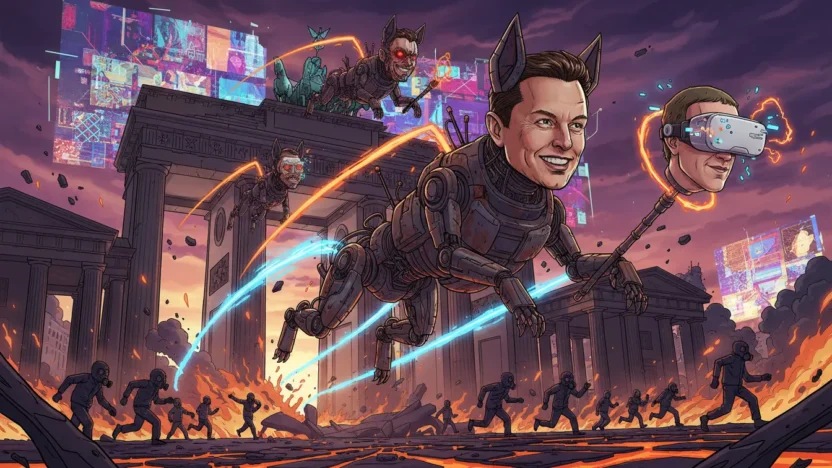
Beeple’s Berlin exhibit has turned a museum into something closer to a fever dream — and the art world is paying close attention. Robot dogs, modeled after the Boston Dynamics Spot platform, now roam gallery floors wearing the faces of Elon Musk and Mark Zuckerberg. It is absurd. It is deliberate. And it is sending a signal that extends well beyond the gallery walls.
The artist behind some of crypto’s most legendary NFT sales has once again collapsed the boundary between satire and spectacle. This time, the canvas is physical space, not a JPEG. The message, however, is unmistakably digital-native.
For those tracking the intersection of crypto culture and mainstream influence, this exhibit is not just art. It is a cultural document — a timestamp of where power, technology, and creative resistance are colliding in 2024.
When Beeple roams robot dogs through Berlin, the art world isn’t the only audience
Mike Winkelmann, known globally as Beeple, made his name synonymous with NFTs when his “Everydays: The First 5000 Days” sold for $69.3 million at Christie’s in March 2021. That single transaction reshaped how the world perceived digital ownership. 🎨
But Berlin is something different. The exhibit moves the conversation from blockchain provenance to cultural provocation. Robot dogs carrying the faces of two of the most powerful men in tech are not subtle metaphors. They are blunt instruments — and that is exactly the point.
Beeple has always used his platform to critique power. His digital works frequently featured distorted, grotesque portrayals of political and corporate figures. The Berlin installation simply gives those critiques legs — literally.
Boston Dynamics’ Spot robots have become a shorthand for surveillance, automation, and the creeping presence of tech in public life. Placing Musk and Zuckerberg heads on those frames is not random. It draws a direct line between the platforms these men control and the systems that increasingly monitor, influence, and shape behavior.
Musk owns X, a platform that now blends social discourse with financial transactions. Zuckerberg controls Meta, a company that spent billions trying to build a virtual world people never fully accepted. Both figures sit at the crossroads of attention, capital, and technology. Beeple is asking: who is really the robot here?
Why Berlin, and why now
Berlin carries weight. It is one of Europe’s most culturally charged cities — historically, politically, and artistically. Choosing Berlin for this kind of installation is itself a statement about surveillance, walls, and power.
The timing also matters. Regulatory pressure on crypto is intensifying globally. AI is accelerating faster than governance can track. Tech founders are increasingly visible in political spaces. The cultural anxiety Beeple is tapping into is real and growing.
What this means for the NFT market and digital art’s next act
NFT trading volumes have not returned to their 2021 peaks. The market matured, contracted, and consolidated around quality and cultural relevance. That is precisely where Beeple remains dominant — not through speculation, but through sustained cultural weight. 📡
Physical-digital hybrid exhibits like this one signal a strategic evolution. The most durable NFT artists are not waiting for on-chain markets to recover. They are building presence in physical spaces, using traditional exhibition formats to reassert relevance and expand audiences.
The convergence play that the market keeps underestimating
When blue-chip NFT artists move into physical installations, they create what collectors call a dual-layer asset — cultural capital earned in the real world that flows back into digital demand. It is not a coincidence that artists who exhibit physically tend to see renewed interest in their on-chain work.
For the broader NFT market, Beeple’s Berlin moment is a reminder that the ecosystem’s value was never purely financial. The artists who understood that first are the ones still standing.
What to watch as the exhibit generates cultural momentum
- Secondary market activity on Beeple’s existing NFT catalog across major platforms
- Media coverage cycles — mainstream attention historically correlates with renewed collector interest
- Whether the Berlin exhibit triggers similar physical-digital crossover projects from other NFT artists
The deeper contradiction Beeple keeps exposing
Here is what makes this installation genuinely sharp: Beeple built his empire on the same technological infrastructure controlled by figures like those whose faces now sit on robot dogs. Blockchain, crypto rails, digital platforms — these are the tools that made his $69.3 million sale possible.
The critique is self-aware. It does not pretend to exist outside the system. It critiques from within — which is arguably the only kind of critique that carries real friction. That tension is what keeps Beeple culturally relevant in ways that many of his NFT contemporaries are not.
The Berlin exhibit is not a farewell to digital art. It is a repositioning — a statement that the most powerful work lives at the edge of discomfort. As the NFT market searches for its next narrative, the artists who embrace that discomfort are the ones building lasting signal. Watch what collectors do next. That will tell you everything.