
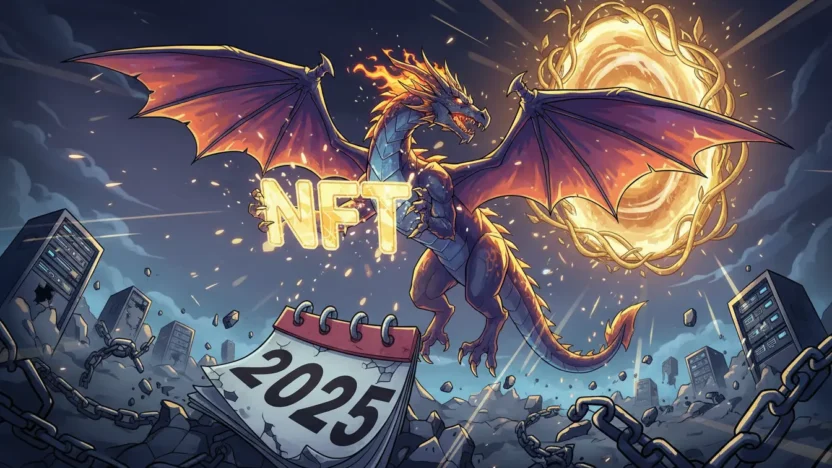
NFTs are back in the conversation — and this time, the buzz feels less like nostalgia and more like a structural re-evaluation. The question dominating crypto circles in 2025 is no longer if NFTs matter, but whether the market has finally matured enough to sustain them. Yahoo Finance recently spotlighted the resurgence narrative, and the signal is hard to ignore.
The 2022 collapse wiped out billions in paper value and left millions of holders with illiquid JPEGs. But underneath the wreckage, builders kept building. That quiet persistence may be setting the stage for something more durable than the last cycle’s speculative frenzy.
What’s different now isn’t just price action. It’s the infrastructure, the use cases, and the types of buyers re-entering the space. The NFT story in 2025 is not a repeat — it’s a rewrite.
Why the NFT comeback narrative won’t die
Every bear market creates a graveyard of overvalued assets. NFTs were no exception. 🪦 Floor prices collapsed. Trading volumes evaporated. Major platforms saw activity drop by staggering percentages from their 2021 peaks.
Yet here we are in 2025, and the question Yahoo Finance is openly asking — are NFTs back? — signals a meaningful shift in mainstream perception. When legacy financial media starts revisiting a narrative, it’s often because underlying data is moving before retail attention catches up.
The structural case for NFTs never fully disappeared. Digital ownership, provenance verification, and tokenized identity remained compelling use cases even when prices collapsed. The market didn’t invalidate the technology. It invalidated the speculation layered on top of it.
The gap between hype and utility is finally closing
In 2021, the dominant NFT buyer was a speculator. Flip culture was king. Projects launched with no roadmap, no utility, and no long-term thinking — just a mint price and a Discord server.
That era is over. What’s emerging in 2025 looks fundamentally different. NFTs tied to gaming assets, event ticketing, real-world asset verification, and creator monetization are gaining traction. The floor isn’t JPEG speculation — it’s functional digital infrastructure.
Platforms like those accessible on Binance NFT and Coinbase’s ecosystem have quietly evolved their offerings. The emphasis has shifted from profile picture collections to programmable assets with embedded utility. That’s not a minor cosmetic change. It’s a philosophical one.
What on-chain behavior is actually suggesting
Trading volume alone doesn’t tell the full story. What matters more is who is buying and why. In previous cycles, wallet data showed high-frequency flipping behavior — assets changing hands multiple times in 24-hour windows.
Emerging patterns in 2025 suggest longer holding periods. That’s a behavioral signal worth watching. It implies buyers are accumulating with intent, not simply riding momentum for a quick exit. Conviction-driven accumulation tends to precede more sustainable price discovery.
It doesn’t mean risk has disappeared. Liquidity in NFT markets remains thinner than fungible token markets. A sharp macro shift or a broader crypto correction could compress NFT floor prices rapidly. The illiquidity premium is still very real.
The assets and ecosystems quietly leading the charge
Not all NFT categories are recovering equally. 🎮 Gaming-linked NFTs and digital collectibles tied to established intellectual property are outperforming legacy PFP projects. The value proposition is clearer, the audience is more defined, and the utility is tangible.
Established blue-chip NFT collections — those that survived the bear market with active communities intact — are also showing signs of life. Floor prices on select collections have begun recovering from multi-year lows. This isn’t a uniform rally. It’s selective, which is actually healthier than the 2021 tide-lifts-all-boats dynamic.
Institutional and brand attention is re-entering quietly
Major brands briefly experimented with NFTs in 2021 and 2022, then quietly stepped back as prices cratered and reputational risk mounted. That hesitation appears to be fading. Brands are re-exploring NFT-based loyalty programs and digital ownership mechanics — this time with quieter launches and less hype-driven marketing.
The shift in tone is deliberate. No one wants to be associated with another bubble narrative. But the underlying experimentation is very much alive. When institutional and brand money moves quietly, it tends to move with more conviction than the retail-driven noise of the last cycle.
Key metrics to watch as the narrative develops
- Monthly active wallets interacting with NFT contracts — rising wallet counts signal organic demand growth
- Average hold time per collection — longer holds suggest conviction, not speculation
- Secondary market royalty compliance — a healthy creator economy is essential for long-term ecosystem health
- Cross-chain NFT activity — expansion beyond a single chain signals maturing infrastructure
The contradiction at the heart of the NFT comeback story
Here’s the tension that most recovery narratives skip over. The very things that make 2025’s NFT market healthier — lower hype, utility focus, slower adoption — also make it less exciting to speculative capital. And speculative capital is what drives explosive price appreciation.
A mature NFT market might never produce the 10,000% gains that made Bored Apes and CryptoPunks legendary. That’s not necessarily bad. But it does mean the narrative needs to be reframed — from get-rich-quick instrument to digital asset class with sustainable value mechanics.
That reframing takes time. It also takes a broader crypto market environment that supports risk appetite. If Bitcoin and Ethereum continue their 2025 momentum, capital will cascade into higher-risk assets — and NFTs will benefit. If macro conditions tighten, NFT liquidity will be among the first to compress.
The most important signal to watch isn’t a floor price — it’s whether new buyers entering the NFT market in 2025 are staying. Retention, not acquisition, will determine if this comeback has structural legs or simply another seasonal bounce dressed up as a renaissance.