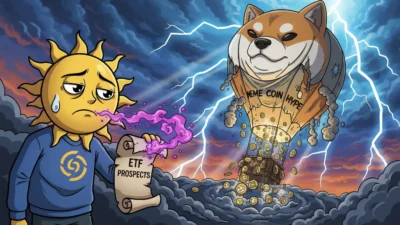

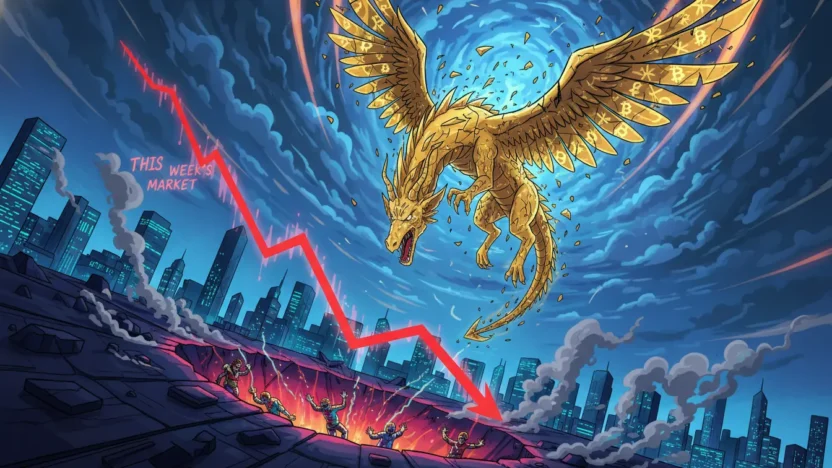
Bitcoin, XRP, Ethereum, and Solana are dropping this week — and the move is starting to feel less like a dip and more like a structural reset. The broad selloff across major assets has rattled sentiment across global exchanges, from Binance to Coinbase.
What makes this pullback notable isn’t just the price action. It’s the timing. Multiple assets are declining in near-perfect synchrony, which historically signals a macro-driven unwind rather than project-specific weakness.
Something coordinated is happening beneath the surface. And understanding why matters far more than watching the candles fall.
When the whole board turns red at once
Crypto markets rarely move together this cleanly without an external catalyst. When Bitcoin, XRP, Ethereum, and Solana all slide in the same window, the sell pressure typically originates outside the ecosystem itself.
This week appears to be no exception. Broader financial market uncertainty has bled directly into digital assets, dragging down even tokens with strong recent momentum.
The pattern is familiar. Risk-off sentiment in traditional markets tends to hit crypto with amplified force. Liquidity exits quickly, and leveraged positions collapse in sequence.
The macro hand behind the selloff
Global macro conditions have remained persistently hostile to speculative assets. Elevated interest rate expectations, dollar strength, and uncertainty around economic policy have kept institutional risk appetite compressed.
When traditional markets sneeze, crypto markets tend to catch pneumonia. That dynamic is fully in play this week.
Traders who built positions during the recent rally are now facing the uncomfortable reality that sentiment can shift fast. 💡 The speed of the reversal matters — slow declines invite buying; sharp drops trigger panic.
Leverage is the accelerant, not the cause
One layer below the macro noise is a structural vulnerability: overleveraged positions across major exchanges. When prices dip suddenly, liquidations cascade and accelerate the move downward.
This is not a theory — it’s a mechanism that repeats across every significant crypto correction. The initial catalyst may be external, but leverage transforms a pullback into a flush.
On platforms like Bybit and Binance, liquidation events during coordinated drawdowns often exceed hundreds of millions of dollars within hours. That kind of forced selling isn’t rational — it’s mechanical.
Why Bitcoin’s slide is the one to watch most closely
Bitcoin doesn’t just lead the market in size — it leads in signal. When BTC weakens, altcoins don’t just follow; they typically fall harder and recover slower.
This week’s Bitcoin decline is particularly telling because it comes without a clear single headline trigger. That suggests the selling is coming from within — profit-taking, position reduction, or quiet institutional de-risking.
Each of those scenarios carries different implications for how long the pressure lasts.
XRP, Ethereum, and Solana aren’t the story — they’re the echo
XRP’s decline this week reflects its sensitivity to overall market mood. Despite recent legal and regulatory tailwinds, XRP cannot fully decouple from a Bitcoin-led selloff.
Ethereum faces its own complexity. Network activity and development momentum remain strong, but price action follows liquidity — and right now, liquidity is retreating.
Solana’s drop is perhaps the sharpest reminder of altcoin dynamics. Assets that rally fast also correct fast. SOL’s recent strength made it a prime target for profit-taking when sentiment turned.
The rotation risk hiding in plain sight
There’s a quiet rotation happening that most retail participants miss. As crypto prices fall, some capital doesn’t leave the space entirely — it waits on the sideline in stablecoins.
That dry powder matters. It means the selloff may be sharper than it is structurally damaging. But it also means recovery depends on a clear catalyst to pull that capital back off the bench.
What the next few sessions will actually reveal
The critical question isn’t whether prices bounce. Bounces are almost guaranteed in volatile markets. The question is whether buyers return with conviction or merely with reflexive dip-buying behavior.
Watch Bitcoin’s ability to hold key support on daily closes. A series of weak closes — even without dramatic further decline — signals distribution, not accumulation.
For Ethereum and Solana, volume on any recovery attempt will matter more than price alone. Low-volume bounces in bearish macro conditions are traps, not trends.
XRP holders should monitor whether broader regulatory optimism can hold the floor even as macro pressure persists. If it can, XRP may demonstrate a rare moment of relative strength worth tracking closely.
The real signal this week isn’t the drop itself. It’s what the market does when the dust settles — and whether the structure that forms next looks like a base or a breakdown continuing in slow motion.