
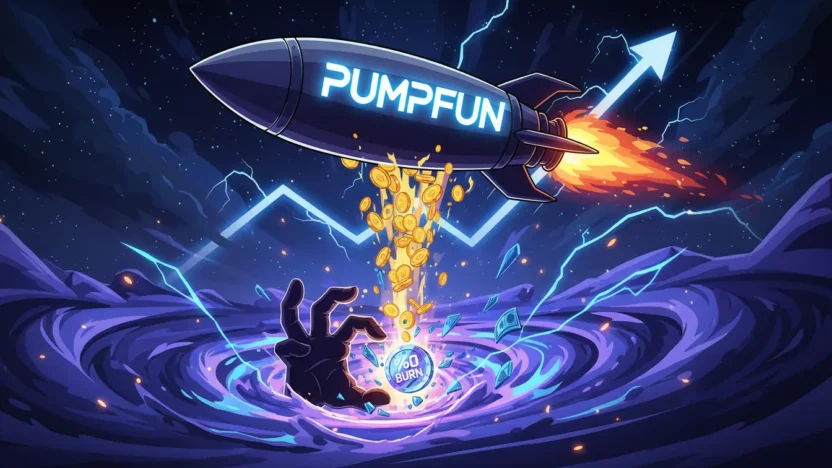
Pump.fun just rewrote its value proposition in one announcement. The viral Solana-based token launchpad has unveiled a 50% revenue buyback-and-burn model for its native token, a structural pivot that transforms the platform from a pure revenue engine into a deflationary ecosystem participant.
This isn’t a minor tokenomics update. It’s a signal that Pump.fun is playing a longer game — one where platform dominance translates directly into token scarcity.
The move arrives at a charged moment for the memecoin launchpad space. Competition has intensified, on-chain activity has matured, and communities are demanding more than just hype. Pump.fun appears to be answering that pressure with something concrete: skin in the game.
The real reason a buyback-and-burn changes everything for Pump.fun
At its core, a buyback-and-burn model creates a mechanical link between platform revenue and token value. Every dollar the platform earns becomes a force that reduces circulating supply. 🔥
With 50% of revenue committed to this mechanism, the model is aggressive by any standard. Most protocols that implement similar structures allocate far less — often in the 10% to 20% range.
This matters because Pump.fun has been one of the highest-revenue applications on Solana. The platform has generated significant fees through its token creation and trading activity. Directing half of that flow toward buybacks isn’t a symbolic gesture — it’s a substantial supply shock in the making.
The hidden narrative here is confidence. You don’t commit 50% of revenue to burns unless you believe revenue will remain robust. This announcement is also a forward-looking statement about the platform’s expected earnings trajectory.
What separates this from typical tokenomics theater
Crypto has a long history of projects announcing burn mechanisms that deliver little real impact. Token burns only matter when the underlying revenue is real and recurring.
Pump.fun’s model is anchored in actual platform activity — fees from millions of token launches and trades. That’s a fundamentally different base than inflationary reward recycling or one-time treasury burns.
The distinction is structural. Revenue-driven burns create a self-reinforcing loop: more platform usage generates more fees, which funds more buybacks, which tightens supply, which strengthens token price incentives. That loop only breaks if usage collapses.
Why timing this announcement now is strategically deliberate
Pump.fun didn’t launch this model in a vacuum. The memecoin supercycle that defined early 2024 has cooled considerably. Launchpad volumes have pulled back from peak levels across the board.
Announcing a deflationary mechanism during a volume trough is a calculated move. It shifts the conversation from short-term activity metrics to long-term token value accrual. It also gives holders a reason to maintain conviction through lower-volume periods.
This is narrative management at a sophisticated level. The platform is essentially saying: even when the meme frenzy quiets, the burn never stops.
The competitive pressure this creates across launchpad rivals
Competing launchpad protocols now face an uncomfortable question. Can they afford to match this model — and if not, how do they differentiate? 📊
A 50% revenue commitment to buybacks sets a new benchmark in the launchpad sector. Platforms that offer weaker tokenomics linkage to revenue will face increasing pressure to either restructure or accept a valuation discount relative to Pump.fun.
This is where the announcement has its broadest market implication. It doesn’t just affect Pump.fun’s token. It forces a reevaluation of how the entire launchpad vertical is valued by investors and traders.
What the market will be watching most closely
The critical variable now is execution consistency. Announcing the model is one thing. Deploying buybacks transparently and on schedule is another entirely.
On-chain observers will be tracking wallet activity closely. Any delay or opacity in actual burn transactions could erode the credibility the announcement is designed to build.
The second variable is revenue resilience. If Solana memecoin activity picks up in the next market cycle, the burn mechanism becomes exponentially more powerful. If activity remains subdued, the impact will be gradual rather than dramatic.
Key signal to monitor
Watch the ratio between verified on-chain burns and reported revenue figures. Consistent alignment between those two data points will be the clearest proof that this model is functioning as designed — not just performing on paper.
A structural bet on platform longevity
The deeper story behind this announcement is that Pump.fun is evolving its identity. It launched as a meme factory. It is now positioning itself as a sustainable, value-accruing protocol.
That transition is never guaranteed to succeed. But the mechanics being put in place give the token a structural argument that pure speculation cannot offer.
For the broader market, this moment is worth noting as a precedent. Revenue-backed deflationary models may become a competitive baseline for launchpad tokens — not a differentiator, but a table stake.
The real test arrives when the next wave of on-chain activity hits. If Pump.fun’s burn volume during peak conditions proves material, the model will have validated itself. That is the moment the market will reprice — not today, but when the receipts arrive.